engineers working on energy storage PCS, photovoltaic inverters, power supplies for computing, BMS, and converters have likely all experienced this: during component selection, the datasheet specifications appear fully met; prototype testing goes smoothly; yet once the complete system is installed, undergoes long-term aging tests, and is deployed in large volumes, a host of issues emerge one after another: zero-point drift occurs quietly, small-current readings fluctuate erratically, cabinet stray magnetic interference causes errors to exceed limits, and maintaining consistent performance across large batches proves extremely difficult.
Currently, the mainstream domestic magnetic current sensors follow three approaches: Hall effect, TMR, and fluxgate. There is no universally “best” model; only by accurately assessing the operating conditions and selecting the right solution can you choose a cost-effective option that is reliable and easy to maintain.
Hall (open-loop / closed-loop)
Highlights: Domestic development started early, the industrial chain is mature and stable, delivery is controllable, and overall costs are well balanced. The closed-loop Hall sensor relies on magnetic balance compensation, achieving both linearity and response speed; after years of validation in high-power projects, it is a proven, market-tested solution.
limitations : The temperature drift performance is moderate; when dealing with weak milliamp-level currents, it is easily affected by core remanence and stray magnetic fields on site, resulting in a ceiling on long-term zero-point stability.
Applicable scenarios : PCS, photovoltaic inverters, motor busbars, high-power converters, and other high-current sampling applications; suitable for projects with large production volumes that require a balance between reliability, delivery lead time, and cost.
Open-loop Hall: focuses on high cost-performance, suitable for applications that only require overcurrent protection and rough monitoring, with relaxed requirements for sampling accuracy.
TMR tunnel magnetoresistance
Highlights: Naturally high sensitivity and excellent signal-to-noise ratio, with wide bandwidth and low power consumption. It is extremely easy to implement as a surface-mount, miniaturized device, and excels at capturing transient waveforms in high-frequency SiC/GaN circuits, perfectly aligning with industry trends toward on-board power integration and device miniaturization.
Limitations : In cabinet environments with extremely high currents on the order of thousands of amperes and complex, crowded magnetic fields, the requirements for magnetic circuit design are very stringent, making it unsuitable for direct replacement of high-power closed-loop Hall sensors.
Applicable scenarios : high-frequency switching power supplies, on-board DC-DC converters, fast charging, and computing power supplies; for small-range on-board sampling, projects that prioritize compact size and high-speed signal acquisition can give these products priority consideration.
fluxgate
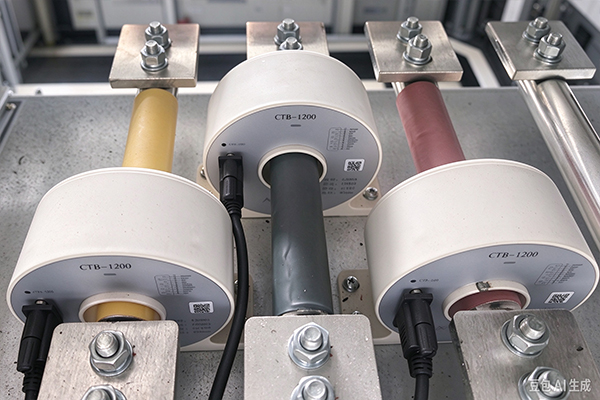
fluxgate current sensor , is more like a “specialist” in the field of DC measurement.
It relies on the magnetic-core excitation demodulation principle, offering greater stability when dealing with weak DC signals: it exhibits outstanding low-temperature drift, excellent long-term zero-point stability, and superior repeatability in zeroing upon power-up and shutdown. For weak DC variations at the microampere and milliampere levels, the fluxgate current sensor can achieve more stable detection; moreover, it demonstrates stronger suppression of complex stray magnetic fields within the cabinet, helping to reduce the risks of false alarms and missed detections.
Therefore, in applications such as battery quiescent leakage current detection, DC insulation monitoring, high-precision BMS, precision DC sources, and scenarios requiring long-term quiescent monitoring or state-of-charge integration, fluxgate current sensors are often one of the more suitable technical approaches.
Limitations: The backend excitation and signal conditioning circuitry are more complex, resulting in a higher initial debugging threshold; for the same measurement range, the device is larger in size and more expensive;
Applicable scenarios: scenarios such as standby leakage current in energy storage batteries, DC insulation monitoring, precision DC sources, high-accuracy BMSs, and laboratory calibration equipment—these applications require continuous monitoring of extremely small currents and rely on sampled data for safety alerts and state-of-charge integration. In such cases, the fluxgate current sensor is a reliable choice.
Quick selection one-sentence comparison
High-power busbars, PCS, inverters, and motor drives—ensuring weighty mass production and stable delivery → Closed-loop Hall sensors
Basic overcurrent protection, prioritizing cost control and low precision requirements → Open-loop Hall
High-frequency power supply, onboard low-current sampling, pursuing compact size and high bandwidth → TMR
Microamp-level leakage current and precision DC acquisition, with stringent zero-point stability requirements and the need for long-term quiescent monitoring → fluxgate current sensor
Tips for Avoiding Pitfalls in Model Selection
Before comparing nominal parameters such as accuracy and bandwidth, first clarify four on-site issues: the overall operating temperature range, the typical operating current range, the switching frequency, and the cabinet’s electromagnetic interference environment. No matter how impressive the specifications may be, if the technical approach is mismatched with the actual operating conditions, even…Magnetic Flux Gate Current Sensor, just like “suffering from water and soil incompatibility” on site.
Today, domestic current sensor manufacturers across all three product lines are continuously iterating and refining their offerings, no longer relying solely on imported solutions. By understanding your own operating conditions and selecting the right technical approach, achieving stable sampling and hassle-free mass production is actually quite straightforward.