engineers working on energy storage PCS, motor test benches, and power electronics testing have almost all encountered the pitfalls of sensor selection: the specified parameters look good, and laboratory tests at room temperature proceed normally; however, once subjected to high- and low-temperature aging or prolonged grid-connected operating conditions, issues such as data drift, poor repeatability, and inaccurate power calculations arise, making it impossible to reproduce the test results.
Many selection issues stem not from hardware failure, but from focusing solely on single-point nominal parameters while overlooking the overall performance under real-world operating conditions. When choosing high-precision voltage sensors, , you don’t need to pore over the entire datasheet—by concentrating on the 3 core metrics, you can quickly evaluate the product and the supplier, thereby reducing rework later on.
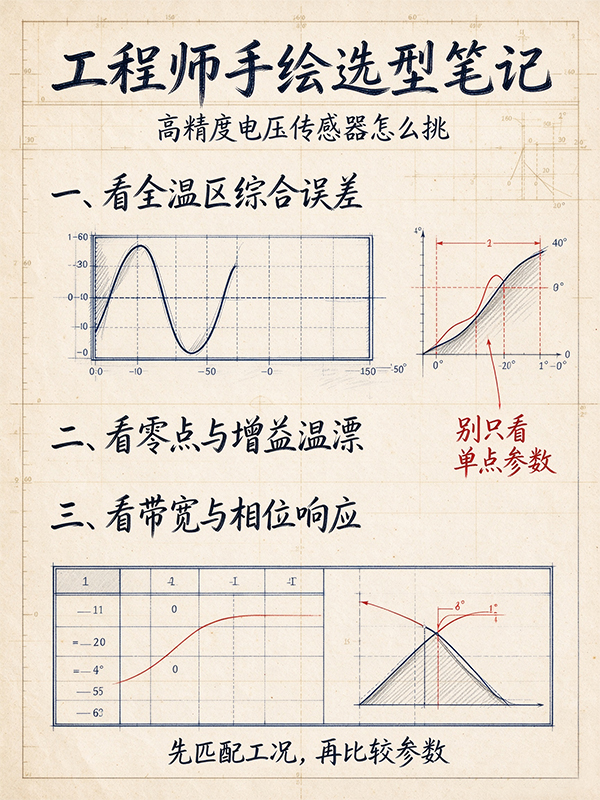
1. Global measured accuracy: Don’t just look at single-point metrics
Many products only specify the accuracy at room temperature and at the rated point, which is the most common selection trap. Single-point static accuracy cannot represent the true measurement performance under the full range of operating conditions.
In actual use, errors accumulate due to ambient temperature variations and differences in the measurement range. When evaluating, focus on the comprehensive error across the entire temperature range and full scale , which encompasses overall performance metrics such as linearity, zero point, and repeatability. When verifying suppliers, prioritize requesting measured calibration reports at both high and low temperatures, rather than relying on theoretical calculations. Pay particular attention to accuracy in the small-range segment and near the critical range, to prevent sampling jumps.
2. Temperature drift: the lower limit of stability in long-term continuous testing
Temperature drift is difficult to detect in short-term tests, but in long-term operating scenarios such as energy storage monitoring and motor durability test benches, temperature drift continuously accumulates errors. Cabinet heating and ambient temperature variations lead to zero-point and gain offsets, directly causing data inconsistencies.
When selecting , pay attention to the zero-point temperature drift and gain temperature drift specifications. Choose a supplier with mature aging processes and an in-factory temperature-controlled calibration system to suppress parameter shifts caused by temperature, maintain long-term measurement stability, and reduce the workload of subsequent calibration and maintenance.
3. Bandwidth and Phase Characteristics: Match the signal under test, and be cautious that the parameters only specify amplitude values
does not need to blindly pursue higher bandwidth; parameter selection should match the signal under test. In DC steady-state scenarios, bandwidth requirements are low; when dealing with PWM waveforms, voltage transients, and high-frequency pulsating signals, bandwidth and response speed become critically important.
Here, the phase error is easily overlooked. Many manufacturers only specify the magnitude bandwidth. If the system requires simultaneous voltage and current acquisition and power calculation, even a small phase deviation can lead to inaccuracies in power computation. When selecting voltage sensors, in addition to bandwidth, be sure to verify the measured phase response data as well.
In addition to the parameters, the supplier’s three supporting capabilities are equally critical.
meeting the specifications is only the foundation; implementation capability determines the project’s progress efficiency:
✅ Offers individual standalone calibration and provides traceable calibration documentation, meeting testing and metrology requirements;
✅ Supports customization and adaptation of measurement ranges, output interfaces, and more, aligning with equipment installation and data acquisition plans;
✅ The technical team is familiar with the on-site conditions of power electronics testing, assists in troubleshooting sampling chain issues, and shortens the debugging cycle.