In the fields of new-energy electrical control, energy storage, high-end power supplies, and variable-frequency industrial applications, the demands for precision and stability in power testing are continuously increasing. As the core device for analyzing electrical parameters, whether the final data is accurate and reliable—and thus capable of supporting energy-efficiency optimization and compliance assessment—depends not on the host’s computational power, but on the quality of front-end current-signal acquisition. The accompanying current sensors are precisely the cornerstone of the entire precision testing system.
Traditional testing schemes often suffer from waveform distortion, zero-point drift, phase deviation, and missed detection of weak signals. Even minor errors in current measurement can directly lead to systematic biases in power, losses, harmonics, and energy-efficiency parameters. To avoid testing blind spots and enhance data reliability, the high-precision current sensor has become the mainstream standard configuration, while the fluxgate current sensors , which are tailored for demanding high-end applications, represent an even more advanced upgrade solution for high-end power analysis and testing.
High-precision current sensor: solidifying the foundation of power test accuracy
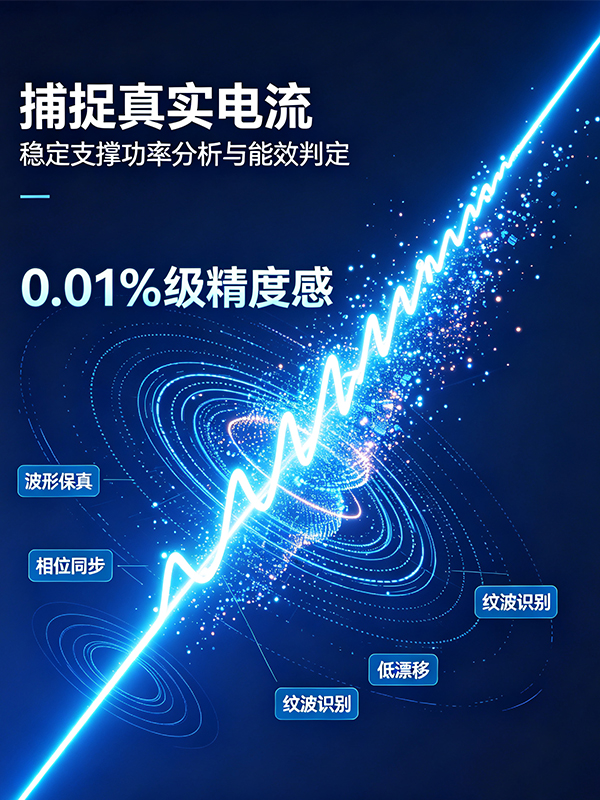
current is the core variable in power calculations, and its acquisition accuracy directly determines the measurement performance achievable by the entire test system. The high-precision current sensor has been optimized and upgraded for precision metrology, product development, and energy-efficiency testing applications, addressing the accuracy limitations of conventional current transformers and standard Hall-effect devices. Leveraging the excellent linearity and low temperature drift of , along with its precise phase‑tracking characteristics, it can provide a high‑fidelity, distortion‑free raw current signal to power analyzers.
It provides full‑range coverage of complex operating conditions, including steady‑state AC and DC signals, pulsating currents, and weak ripple, enabling precise acquisition across the entire measurement range while effectively suppressing data drift caused by ambient temperature fluctuations. At the same time, its excellent phase consistency perfectly aligns with the power analyzer’s synchronous sampling logic, significantly reducing power calculation errors and ensuring that energy efficiency analysis, loss testing, and harmonic detection results more accurately reflect the equipment’s actual operating state, thereby fully unleashing the power analyzer’s high‑precision analytical capabilities.
Fluxgate Current Sensor: Addressing Challenges in Testing Under Complex Operating Conditions
In ultra-high-precision, ultra-low-current, long-term stability test scenarios, the fluxgate current sensor , leveraging its core zero-flux closed-loop technology, serves as an excellent complementary solution for power analyzers. Unlike traditional sensing devices, it achieves a zero-flux operating state through real-time magnetic circuit compensation, significantly reducing accuracy degradation caused by residual flux in the magnetic core, making it well-suited for demanding scientific research and industrial testing applications.
This device enables seamless, all‑waveform AC/DC measurement without distinction, addressing the pain point of traditional equipment that cannot simultaneously achieve high‑precision sampling for both microcurrents and large currents. Thanks to its excellent electromagnetic shielding and anti‑interference capabilities, it can operate stably in complex industrial electromagnetic environments, accurately capturing transient current fluctuations and subtle high‑frequency ripples. It also boasts ultra‑low zero‑point drift, high repeatability, and long‑term immunity from frequent calibration, making it well suited for demanding applications such as prolonged continuous testing, precision calibration, and dynamic performance analysis.
Scenario Collaboration: Software-Hardware Adaptation, Empowering Precise Industry Iterations
The power analyzer, combined with a high-precision current sensor and the fluxgate current sensor , forms a closed-loop testing system of “precise acquisition + professional analysis,” effectively addressing the common industry issue of a disconnect between “high analytical accuracy” and “poor front-end sampling.”
Whether it’s energy consumption testing for new-energy vehicle electronic control systems, performance verification of energy storage and photovoltaic grid integration, or high-end power supply ripple loss analysis and laboratory precision metrology calibration, this configuration can stably deliver high-precision data, providing a reliable basis for product optimization, fault root-cause analysis, energy-efficiency upgrades, and compliance testing.
Conclusion
Precision power testing—accuracy begins with sensing. High-precision current sensors ensure stable, accurate measurements in routine scenarios, fluxgate current sensors break through the bottlenecks of complex operating conditions and ultra-high-precision testing. Empowering power analysis with premium sensing equipment is a key lever for upgrading quality, enabling precise R&D, and achieving efficient quality control in the power electronics industry, providing robust data support for the iterative development of various high-end power devices.