As AI computing infrastructure undergoes rapid iteration, AIDC power supplies have completely moved away from the steady-state operating logic of traditional IDC voltage-regulating power supplies. High-dynamic transient loads, wide-range voltage conditions, and high-density electromagnetic coupling environments,7×24hContinuous aging tests have become the core standard for the R&D, finalization, and mass-production testing of computing power power supplies. Compared with traditional server power supplies, AIDC PSUs and HVDC DC bus systems place higher demands on electrical parameter measurement.Accuracy traceability, dynamic response, environmental stability, and anti-interference capabilityA magnitude-based enhancement has been proposed.
In real-world engineering testing, numerous issues—such as significant deviations in laboratory data, distorted efficiency curves, missed transient faults, and long-term drift in test data—are not due to design flaws in the power supply itself, but rather stem from insufficient performance of core components at the test end. Conventional industrial-grade current and voltage sensors encounter unavoidable technical bottlenecks under AIDC’s demanding test conditions, making them wholly inadequate for high‑level test calibration requirements. Meanwhile, specialized sensor solutions developed by professional manufacturers of high‑precision current sensors——including , have become the key to addressing the pain points of AIDC power‑supply testing.
I. Lack of linearity across the entire operating range: Conventional sensors cannot meet the AIDC wide-range testing requirements
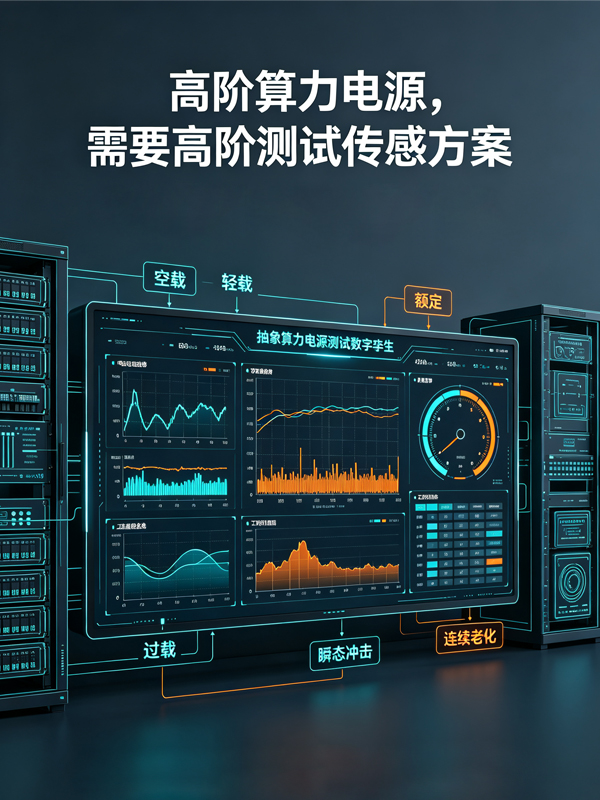
AIDC power supply testing requirements cover all operating conditions, including no-load, light-load, 50% load, rated full-load, short-term overload, and pulse impact load scenarios. Moreover, the measurement accuracy in the light-load, low-power range directly determines the authenticity of key parameters such as the power supply’s efficiency conversion curve, light-load losses, and standby power consumption.
Conventional current and voltage sensors typically employ an open-loop sensing architecture or a conventional voltage-divider sampling scheme, which can only guarantee basic accuracy at the rated operating point. In the small-signal, light-load range, they suffer from severe issues such as degraded linearity, residual zero error, and sensitivity drift. Moreover, these sensors exhibit relatively large temperature coefficients; during high–low temperature cycling tests and long-term power-on aging tests, temperature drift and time drift continuously accumulate, resulting in poor repeatability of test data under the same operating conditions and a lack of traceability. Consequently, they fail to meet the testing requirements for AIDC power supply R&D that align with national standards and advanced industry certifications.
II. Insufficient Dynamic Bandwidth: The Core Fault Signature of Missed GPU Transient Workloads
Unlike the traditional IDC’s constant-load operating mode, the core characteristics of AIDC computing clusters are millisecond-level load transients, high-frequency power pulsations, and instantaneous peak impacts . The GPU cluster can switch power on and off at speeds reaching the microsecond level; the power supply output exhibits dynamic characteristics such as high-frequency ripple, short-term voltage dips, and current oscillations—these are also the key metrics for verifying the AIDC power supply’s dynamic voltage regulation and shock-resistance capabilities.
Conventional sensors generally have low bandwidth and sluggish dynamic response, capable only of acquiring steady-state average values while failing to capture transient abrupt waveforms and high-frequency ripple details. During dynamic load testing, this can result in situations where “steady-state data pass but dynamic hidden defects are missed,” making it impossible to accurately identify latent issues such as power supply transient response delays, oscillation distortion, and abnormal dynamic losses. Consequently, the test bench cannot faithfully replicate the actual operating conditions of the computing power supply, thereby introducing reliability risks for subsequent full-system integration and operation.
III. Weak electromagnetic interference resistance: Severe measurement distortion in high-density computing environments
The AIDC cabinet adopts a high-density integrated design, with densely arranged DC busbar copper bars and highly concentrated switching power supply modules. During operation, it generates strong spatial stray magnetic fields, high-frequency electromagnetic radiation, and conducted interference, resulting in an EMI electromagnetic environment far more complex than that of traditional industrial settings.
Conventional open-loop current sensors have extremely poor immunity to magnetic interference and are highly susceptible to the magnetic fields of nearby busbars and coupling from spatial electromagnetic noise, resulting in signal superposition and distortion. Conventional voltage sensors typically employ a simple resistive voltage divider structure, which offers insufficient electrical isolation margin and a low common-mode rejection ratio. In high-voltage DC busbar environments or under high-frequency switching interference, the sampled signals become heavily contaminated with noise, leading to severe distortion in power calculations, efficiency calibration, and harmonic analysis data, thereby failing to support high-precision power analysis and power‑supply fault root‑cause diagnosis.
IV. Insufficient long-term stability: unable to meet the requirements of long-term reliability testing for computing power supplies
Before mass production, AIDC power supplies must undergo rigorous reliability tests, including thousands of hours of continuous aging, high–low temperature cycling, and repeated start–stop shock tests, placing extremely high demands on the long-term stability and consistency of the sensors. Conventional sensors, constrained by manufacturing processes and architectural limitations, experience component aging, exacerbated zero-point drift, and declining accuracy after prolonged operation, leading to inconsistencies in test data across different measurement cycles. This prevents the establishment of a continuous, traceable test data closed loop, severely impacting product iteration and optimization as well as quality control for mass-produced units.
Professional-grade sensing solution: precisely tailored to AIDC’s full-scenario advanced testing
Addressing the core technical pain points of AIDC power supply testing, , a high-precision current sensor manufacturer specializing in magnetic sensing technology, , based on fluxgate core technology, has developed a dedicated series of current and voltage sensors tailored for computing power supply testing, thereby resolving the performance limitations of conventional sensors at the foundational level.
The product boasts core advantages of ultra-high linearity, extremely low temperature drift over time, and wideband dynamic response ; its accuracy remains stable across the entire measurement range, enabling precise capture of electrical parameters under all operating conditions, including light-load micro‑power consumption, transient impacts, and high‑frequency pulsations. Leveraging a mature magnetic shielding structure and a high common-mode rejection design, it effectively isolates stray magnetic fields and high-frequency electromagnetic interference in high‑density cabinets, ensuring measurement integrity even in complex EMI environments. Meanwhile, its comprehensive electrical isolation design meets safety standards for high‑voltage DC bus testing and is compatible with the mainstream AIDC DC bus conditions of 400V/800V/1000V, making it an ideal match for a full spectrum of R&D test scenarios, such as power efficiency testing, dynamic load calibration, aging reliability testing, and transient fault reproduction.
Conclusion
The technological evolution of AIDC computing power supplies is driving the testing system to upgrade toward high precision, high dynamics, high stability, and strong anti-interference . The inherent structural limitations of conventional sensors can no longer meet the R&D and testing requirements of advanced computing power supplies. By adopting a customized sensing solution from a professional high-precision current sensor manufacturer , it is possible to ensure data accuracy, authenticity, and traceability right at the source of testing, thereby solidifying the testing foundation for AIDC power supply reliability and energy efficiency optimization, and safeguarding the high-quality iteration of computing infrastructure.