In modern industrial feedback control, photovoltaic energy storage testing, power monitoring, and automation systems, the high-precision, high-current sensor plays a critical role. It is not only a current-monitoring tool but also a core safeguard for equipment safety, system efficiency, and intelligent operations and maintenance. Faced with numerous brands, models, and specifications on the market, how can enterprises select the right product? This article will provide a practical guide for industrial procurement, starting from the steps for selecting considerations .
Step 1: Define the application scenario
The requirements for current sensors vary significantly across different applications, and numerous technical parameters must be considered, including measurement range, bandwidth, accuracy, output signal type, electromagnetic interference immunity, and mounting method. Therefore, the first step in sensor selection is to clearly define the application environment :
photovoltaic energy storage system
. Monitors the current of each battery string and supports charge-discharge balancing
. High precision and high stability requirements
Industrial Automation and Motor Control
. Monitoring start-up, acceleration, and load fluctuation currents
. Supports fast response and high dynamic range
inverter and substation
. High-current, high-power devices
. Requires fast overcurrent protection and long-term operational stability
. Electromagnetic interference resistance
Only after the scenario is clearly defined can key parameters such as measurement range, accuracy, and interface be matched.
Step 2: Identify the core technical metrics
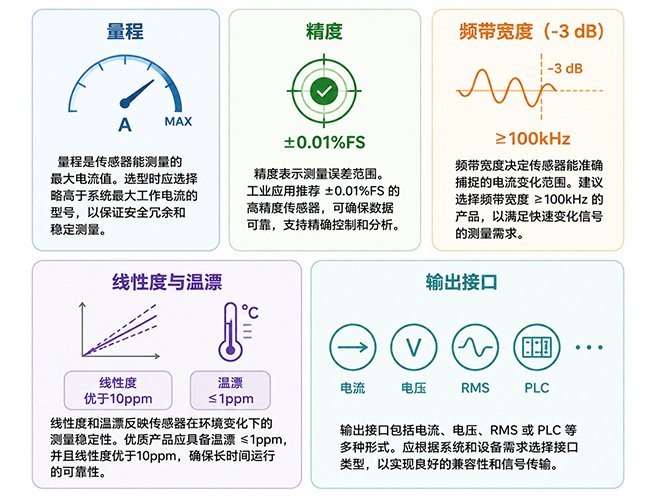
SelectHigh-current sensorAt that time, technical specifications are the key basis:
Step 3: Consider system compatibility
sensors ultimately need to be connected to a control or monitoring system, so interface and compatibility are extremely important:
. Signal output (current signal, 0-5V, 4-20mA) → Suitable for traditional industrial control systems
. Electrical isolation and anti-interference capability → Prevents high electromagnetic interference in industrial environments from affecting measurements
Step 4: Evaluate environmental adaptability
Industrial environments are complex, and sensors must meet the requirements for long-term reliable operation:
. Temperature drift: The consistency of the product’s technical specifications across different temperatures
. Electromagnetic interference resistance: In customer scenarios, strong electromagnetic interference is present
. Time drift: The product’s technical specifications remain stable over long periods of operation
Step 5: Comprehensive evaluation of suppliers and after-sales service
In industrial procurement, in addition to product quality, the supplier’s technical services are equally critical:
. Product Certification and Qualifications (ISO, CE, etc.)
. Provides technical selection support and parameter matching recommendations
. After-sales service and spare parts supply capability
technology and service support determine long-term stable operation and operational efficiency.
Step 6: Testing, Validation, and Pilot Application
After completing the selection of , it is recommended to first conduct a small-scale test:
1. connect the sensor to the actual operating circuit
2. verify measurement accuracy, response speed, and system compatibility
3. Adjust the installation method or selection parameters based on the reference data
has been validated through pilot testing, which can reduce the risks associated with large-scale deployment in the later stages.
Summary
Choosing high-precision, high-current sensors is not just “buying a sensor”; it is also the first step toward ensuring system reliability, safety, and efficiency . .
By following the six-step methodology of —defining the application scenario → matching technical specifications → ensuring system compatibility → assessing environmental adaptability → evaluating suppliers → conducting test verification—industrial procurement professionals can perform equipment selection in a scientific and precise manner, thereby ensuring the long-term safe, stable, and efficient operation of large industrial equipment.